INSTRUCTOR GUIDE
Why Open the Rules
An individual simulation about democratization for comparative politics, political sociology and related courses. Students advise actors in five historical cases, test their explanations against evidence, then apply their reasoning to an invented country.
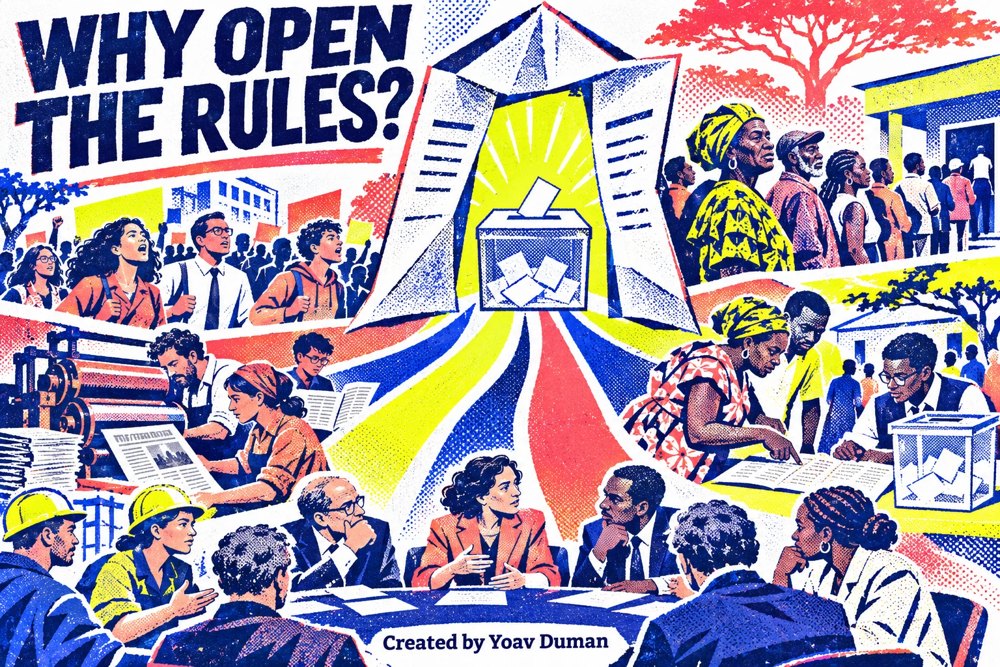
The central puzzle
If people in power control the rules, why would they accept a contest they could lose? The activity asks students to connect a pressure or opportunity to an actor’s possible gain or loss, an action, and a concrete political rule or problem.
What students do
In South Korea, Poland, South Africa, Ghana and Taiwan, students make two linked decisions. Their first advice changes the second situation. They encounter invented responses, then a separate documented history, a formative claim check and a reconsideration of an earlier claim.
The final file compares any two completed historical countries and asks students to advise the invented Republic of Orvessa. No political choice earns a democracy score. An opening does not by itself establish consolidated democracy.
Created by Yoav Duman. Public teaching edition, November 2026. The separate Student Guide, Assignment and Sources accompany this guide.
SETUP AND WORKLOAD
Choose the mode and scope
Set the mode and, in Class, the assigned countries before starting. All five countries are selected by default. Class requires at least two; the other countries remain available with optional writing. Settings stay with the session.
| Mode | Writing and identity | Claim checks and final file |
|---|---|---|
| Explore | Writing, name and class are optional. | Checks may be skipped. Final file opens after any two countries. |
| Practice | Writing, name and class are optional. | Complete checks with feedback and retries. Final file opens after any two countries. |
| Class | Name and class are required. Assigned-country writing and final writing are required. | Complete checks. Final file opens after every assigned country is complete. |
Class entry floors
| Task | Minimum |
|---|---|
| First prediction in each assigned country | 10 words |
| Second-decision reason | Optional |
| Reconsideration in each assigned country | 25 words |
| Comparison of any two completed countries | 40 words |
| Orvessa prediction before feedback | 40 words |
| Orvessa reflection after feedback | 20 words |
All five countries require 13 writing entries and at least 275 words in total. Two assigned countries require 7 entries and at least 170 words. For n assigned countries, the totals are 2n + 3 entries and 35n + 100 words. Second-decision notes, optional countries and later notes add no required writing.
These are length checks, not grades or evidence that an explanation is adequate. Clear notes are welcome. Explore and Practice have no writing minimums.
A flexible teaching sequence
One possible sequence is to introduce the model and work through South Korea, allow independent case work in class or between meetings, then discuss the comparison and Orvessa. Treat this as a provisional plan. Reading and writing time has not been established by a learner pilot; allow pauses and adjust the assigned scope.
COUNTRY WORK
Facilitate the evidence loop
- Read the role, situation and all three evidence cards. Identify what the advised actor wants and what another actor could gain or lose.
- Make the first decision. Predict who might respond and why, using a documented card detail. Keep the detail separate from the response being predicted.
- Read the modeled response and tradeoff, then make the second decision. Its written reason is optional, including in Class.
- Open the documented history, observed rule change, historical number and source key. The student’s imagined route did not cause this history.
- Commit a claim check. In Practice and Class, use feedback and retry until the supported claim is selected. Explore may continue without completing the check.
- Reconsider one earlier claim using historical evidence and the number, then finish the country. Replays and later dated revisions remain optional.
Keep three kinds of statement distinct
| Statement | How to treat it |
|---|---|
| Documented fact | A source records an event, rule, result or stated reason. Use the evidence label to locate its support. |
| Historical inference | A proposed link between facts, such as a possible motive or the effect of pressure. Explain the link and its uncertainty. |
| Modeled possibility | An invented branch response or thought experiment. It tests an assumption; it is not historical evidence or a certain prediction. |
Worked interpretations become available after the first committed check, including an incorrect answer, or after an Explore skip. A correct check is still needed to advance in Practice and Class. Interpretations are explanations to test, not proof of private motives. A replay can retain access from an earlier attempt.
Make revision specific
Students quote or restate their own earlier claim and explain why they would keep, change or leave it uncertain. They identify a historical person or group, action and rule or problem, and use a documented detail to support the link. They use the number to test that same claim: what it counts, its total, and one conclusion it cannot establish.
The game provides plain-language terms, evidence links, progressive hints and a causal example about an invented club. All historical facts needed for the tasks are in the activity; external reading is optional.
CASE NOTES FOR INSTRUCTOR REVIEW
South Korea and Taiwan
South Korea 1987 to 1988
Documented sequence. Torture, a cover-up and blocked constitutional debate preceded June mobilization. Students were joined by religious and opposition activists, office workers and industrial workers (KR2-KR3). Roh Tae-woo publicly accepted direct elections and linked the concession to ending unrest and reconciliation (KR4). Party agreement and the referendum institutionalized direct presidential voting (KR5).
Interpretation to test. Wider organization may have raised the cost of resisting reform; a concession still needed a legal route. Roh’s public statement establishes a stated reason, not all private motives. Growth and a larger educated middle class were background conditions, not a demonstrated sufficient cause of constitutional change (KR1).
Number. Roh’s rounded 36.6% counts valid votes for candidates in the December 1987 election. It excludes invalid ballots and nonvoters. Other candidates together received 63.4%, divided among rivals. Adding these shares cannot predict a hypothetical united race (KR6).
Claim-check key: the supported explanation connects broader pressure, a governing concession and constitutional change. A governing-party victory does not mean the presidential selection rule stayed the same.
Taiwan 1986 to 1996
Documented sequence. The DPP formed despite the party ban in 1986 and was tolerated. Chiang Ching-kuo ended martial law in 1987. After Chiang died in January 1988, Lee Teng-hui succeeded him. Party legalization in 1989, full national-body elections in 1991-1992 and direct presidential voting in 1996 were distinct steps (TW2-TW6).
Interpretation to test. The revision compares two hypotheses: suppressing opposition became costly, and toleration could help leaders preserve influence. One fact may fit both. Neither growth nor a later KMT victory establishes what officials privately wanted in 1986; students identify evidence that could distinguish the hypotheses.
Number. Lee won 54.00% of votes counted for candidates in 1996. This is not a population share and does not establish leaders’ expectations ten years earlier (TW6).
Claim-check key: broader competition can coexist with a governing-party victory. The changed rule and the winner are different observations.
CASE NOTES FOR INSTRUCTOR REVIEW
South Africa and Poland
South Africa 1990 to 1994
Documented sequence. The Black majority lacked national voting rights. Resistance, repression and outside pressure formed the context for negotiations. De Klerk publicly presented talks as an alternative to conflict and Soviet changes as altering security concerns (SA1-SA3). Negotiations continued through violence and breakdowns (SA4).
The interim Constitution combined adult voting without racial exclusion, rights protections and temporary cabinet access for parties winning at least 20 Assembly seats (SA5). The National Assembly elected Mandela president after the 1994 election. The ANC, National Party and IFP entered government (SA6). This was not a direct presidential election.
Interpretation to test. Pressure could make exclusion harder to sustain, while temporary influence could reduce a losing party’s fear of total exclusion. This is a possible interaction, not a measurement of each cause or proof of every private motive. Cabinet access did not reserve a legislative majority or create a permanent racial veto.
Number. The National Party won 82 of 400 seats, exceeding the 20-seat cabinet threshold. The ANC won 252 and IFP 43. Each party had to qualify separately (SA6).
Claim-check key: qualifying parties could retain some influence in government after losing a majority. The threshold concerned cabinet access after voting, not permission to contest the election.
Poland 1988 to 1991
Documented sequence. Strikes linked material demands to legal Solidarity and association rights (PL1). Polish leaders chose talks before Gorbachev supported the plan (PL2-PL3). The 1989 bargain legalized Solidarity, restored the Senate and opened every Senate seat, while reserving 65% of Sejm seats for rulers and allies (PL4).
Solidarity-backed candidates won all 161 open Sejm seats and 99 Senate seats. Two former ruling-bloc allies supported a Solidarity-led coalition. Reserved seats did not require continued coalition loyalty. All parliamentary seats opened in 1991 (PL5-PL6).
Interpretation and number. Soviet support may have reassured negotiators; its separate effect is uncertain. The 35% measures competitive Sejm seats, not votes. Later change does not establish that rulers planned to surrender all protected offices.
Claim-check key: the Polish plan preceded Soviet approval. Support may have reassured its authors, but this record does not isolate its contribution.
CASE NOTES AND ORVESSA
Ghana and the final transfer
Ghana 1992 to 2001
Documented sequence. Voters adopted the constitution in April 1992; the party ban was lifted in May. Rawlings won the presidential election, and major opposition parties disputed it and boycotted the parliamentary contest. The constitution took effect on January 7, 1993 (GH1-GH2).
Observers reported registration problems. The Carter Center did not observe a systematic pattern of rigging but could not determine whether the allegations were true (GH3). Legal commission safeguards were followed by inter-party meetings, a publicly checked register, party copies and transparent boxes. Opposition parties competed in 1996; which reform caused their return remains uncertain (GH4-GH5).
A separate two-term rule prevented Rawlings from running in 2000. His party’s candidate, Mills, lost the runoff to Kufuor, who took office in January 2001. Kufuor’s 56.90% is a share of valid votes in the second round, not of the population (GH6).
Claim-check key: public checks addressed election administration; the term limit separately restricted eligibility. Formal independence alone does not establish impartial behavior. The observer account does not prove that no fraud occurred.
Orvessa is invented
Students advise a small team that can support public checks and arrange talks but cannot command parties or the election commission. All parliamentary seats are already open. The voter list is disputed, staff time is limited, and the governing party fears losing every cabinet post. It offers temporary posts to qualifying losing parties. Opposition parties want public checks and a clear end to sharing; they have not agreed to participate.
Students choose a priority, identify whose choice it could change and why, use one historical detail from each of any two completed countries, and identify unfinished work. A contrast counts. For example, Poland’s reserved-seat bargain addresses a restriction Orvessa does not have. Ghana and South Africa offer possible parallels, not required case choices or templates that guarantee success.
After the modeled response, students reconsider one claim from their original prediction. They explain why they would keep, change or leave it uncertain, identify an actor who could refuse the plan, and name one finding that would change their priority. The response supplies a possibility, not new historical evidence.
ASSESSMENT AND DISCUSSION
Review explanations and comparisons
Evaluate the explanation rather than the political choice. The activity does not automatically grade written answers. The claim check gives formative feedback on one distinction; completing it is not evidence that the full causal explanation is strong.
| Criterion in the game | What to look for in the writing |
|---|---|
| Causal connection | A possible gain or loss connects an actor’s action to a concrete rule or problem. When two factors are used, one changes the opportunities, costs or effects of the other. |
| Evidence and numbers | A specific historical detail supports the connection. Facts, inferred motives and imagined responses stay separate. The number uses the right group or total and does not carry a claim beyond what it shows. |
| Revision and comparison | A student gives a reason to keep, change or question an earlier claim, explains where a comparison fits, and identifies where it breaks down. |
The comparison task
Students compare any two completed historical countries. For each, they explain how two factors could have worked together to change an actor’s choice and a concrete rule or problem, using one specific historical detail. They then explain one similarity or difference and one uncertain link. Separate short notes are welcome.
Useful feedback moves
- When a response lists events, point to the missing link between an actor’s expected gain or loss and action.
- When a motive is asserted, ask whether the evidence records it, only fits it, or also fits a competing explanation.
- When two causes are listed, ask how one changes the effect of the other.
- When a number is used, return to its denominator and the conclusion the student is trying to test.
- When a student copies an interpretation, bring the review back to that student’s earlier claim, chosen fact and numerical warrant.
Optional debrief
Use students’ existing comparisons to discuss which rules opened, which actors retained influence, and which links remain uncertain. A common contrast is between access to competition, electoral administration, eligibility and transfer of office. These discussion prompts are teaching options; they add no required written task to the activity.
PRACTICAL TEACHING NOTES
Save resume and collect work
Before students start
- Give the class one stable game link or the standalone HTML file, the mode, the assigned countries and the submission destination.
- Have students confirm Class mode, their name and class, and the assigned country set before choosing Open the country files.
- Explain that work is stored in that browser on that device. It is not an account-based cloud record.
- Provide the Student Guide. Use the printable Assignment as a reference or an alternative place to record the same answers when permitted, without duplicate writing.
Keep a restorable backup
Backup downloads a JSON file that can restore the session. Students should download it before changing devices, moving between website addresses, clearing browser data or resetting. Use Restore in the activity to load it. Restoring replaces the current answers and latest saved work; keep a backup of either copy that matters.
To resume automatically, use the same browser profile on the same device and the same game location. Browser storage belongs to the website origin. Work on yoavduman.com does not automatically appear on Possiblestates.com. A moved or downloaded file may also need a JSON restore. Private browsing and cleared site data can prevent resumption.
If another tab changes the saved copy, the game pauses saving rather than silently overwriting. Download a backup of the current tab before choosing Load latest saved work. If the browser reports that saving is unavailable, keep working only while you can still download a backup.
Collect a report through Canvas
- After the final comparison, prediction and reflection, the student chooses Mark writing ready for review in Class.
- The student uses Download text report or Print / Save PDF and checks the exported file. The concise report retains answers, drafts, attempts, check responses and revisions.
- The student submits that text file or PDF through the assigned Canvas submission. The page itself sends nothing to the instructor. A saved or ready status is not a submission or a grade.
Full record and sources offers a longer export with saved task instructions, reading supports and the historical source appendix. Both export types include only material already opened. Editing an answer returns the ready status to in progress. A JSON backup is for restoration; a report or PDF is for review.
The Sources packet reproduces every historical evidence-key note and locator from the game. Public statements, private conversation records, observer reports, laws and later accounts support different kinds of claim. External reading remains optional.
Enter your own answers directly. Paste and text drop are disabled in For Class response fields. Progress backups stay available. Pasting is available in exploration modes.
Optional debrief
After the first Poland revision, open the seat reservation check. Ask what the agreement protected and how the later cabinet exposes a separate question about party alliances.