The City Is Not the Walls
Instructor guide · Introductory Political Theory
Created by Yoav Duman · October 2026
Teaching purpose
Use this activity before the first class discussion of Aristotle. It introduces ideas from Politics Books I to III, with most attention to Book III, through a fictional charter dispute. It is designed for introductory political theory at a community college, including students encountering political theory for the first time.
Students should arrive able to reconstruct a claim, apply a distinction to an institution or resident, and raise a reasoned objection. Agreement with Aristotle, a particular admission rule, or an instructor's politics is not an outcome.
The case students enter
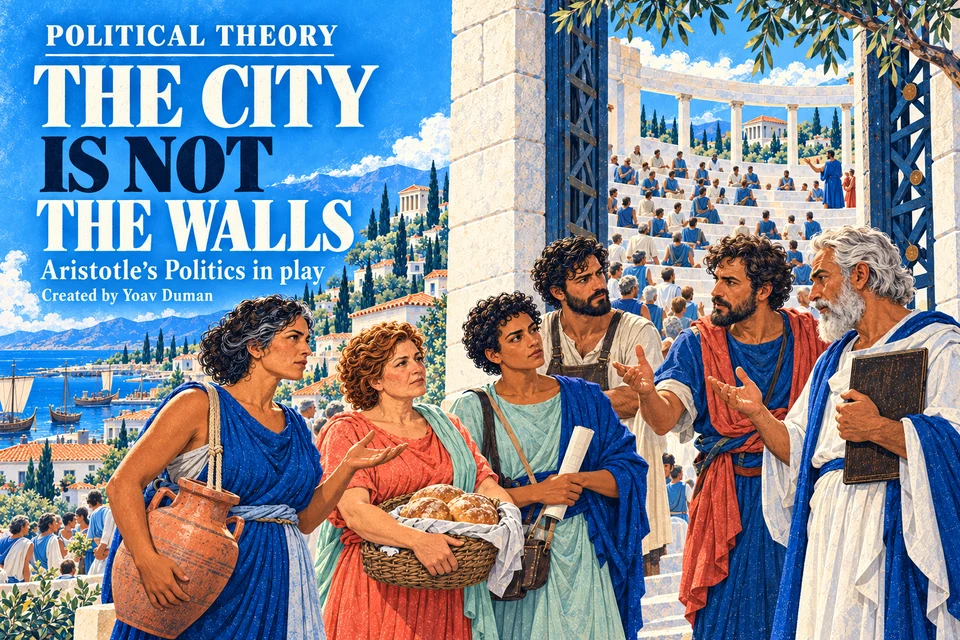
Kallia's old council has fallen. Students set rules for admission, public purposes, property use, water authority, judgment, discretion, and inherited commitments. Six recurring residents make the consequences concrete. The fictional population and illustrations establish a teaching situation; they are not a reconstruction of a particular Greek city.
The complete HTML works offline without a student account. Its source cards and definitions supply the preparation; do not make prior reading a condition for beginning. Assign a primary-text passage after the activity or for the class discussion.
Created by Yoav Duman. Political Theory. Revised inquiry edition, October 2026.
Plan the assignment
Allow about 70 minutes for the activity, with extra time available for reading, writing, and conceptual repair. This is a design estimate, not a measured student completion time. Offer a pause after Round 3 and consider two sittings for a first encounter with the vocabulary.
| Stage | Estimate | Main work |
|---|---|---|
| Round 1 | 10 min | Citizenship, exclusion, civic leisure, and the good life |
| Round 2 | 8 min | Plurality, property, and common use |
| Round 3 | 10 min | Constitutional authority, regimes, and partial justice |
| Round 4 | 12 min | Expertise, collective judgment, and civic excellence |
| Round 5 | 14 min | Law, discretion, succession, and exceptional rule |
| Round 6 | 9 min | Political identity, continuity, and inherited commitments |
| Exit | 7 min | Common advantage, a charter feature, and an objection |
What students produce
There are 23 screens, 11 choices with required short reasons, and five extended writing entries. The 16 entries retain their original minimums: 170 short-response words plus 195 extended-response words, or 365 total. About 630 words are suggested. Completion gates check the presence and length of required writing, not its meaning.
Suggested course instructions
Complete The City Is Not the Walls before our Aristotle discussion. No prior Aristotle reading is required. Read the supplied explanations and sources, explain your choices, and take objections seriously. You may disagree with Aristotle. Export the final PDF, check that it includes your name and all responses, and upload it to this assignment. Bring one question to class. Keep a JSON progress backup if you pause.
Set your own deadline, point value, access arrangements, and policy on collaboration. Individual writing is the default; pairs can discuss a shared playthrough if each student submits an identifiable account of their reasoning.
Protect the theoretical distinctions
Citizenship and exclusion. Aristotle's strict definition concerns participation in deliberative or judicial authority (III.1). Necessity to the community does not itself supply that authority. Examine his arguments about capacity and civic leisure rather than treating the exclusions as a bare list of prejudices. A lack of time caused by working arrangements does not establish an inherent incapacity (I.4 to 7, I.13, III.5).
Nature and the good life. The polis is natural in an argument about the developed end of human capacities, speech, and judgments about justice (I.2). This does not establish that every existing hierarchy is justified. Security and exchange are necessary conditions whose relation to living well remains a political question.
Constitution and office. A constitution organizes authority (III.6). Under every water option in this activity, the eligible assembly retains charter amendment and appointment or removal powers. One water steward does not make the whole charter a monarchy. Ask students to map powers before naming a regime.
Regime and social basis. Number of rulers and the advantage pursued help frame the sixfold classification (III.7), but wealth and poverty do important work in distinguishing oligarchy and democracy (III.8). A wealthy majority is the activity's deliberate counterexample. Aristotle's use of democracy here differs from its usual approving contemporary use.
Partial justice and common advantage. Equal freedom and wealth each capture something relevant, then claim more than they establish (III.9). Ask relevant to which purpose and entitled to which power. The common advantage test still raises the question of who counts within the citizen body. Inclusion alone does not establish that institutions serve a common advantage.
Judgment and virtue. Collective judgment is a conditional argument about how contributions may combine, not a guarantee that crowds are wise (III.11). Good citizenship is relative to a constitution; complete human excellence need not coincide with it in every constitution (III.4). Neither automatic obedience nor permanent conflict captures the full distinction.
Law and exception. Expertise in water engineering does not establish incomparable political and ethical excellence. The exceptional-ruler argument requires that demanding premise before its inference about unequal shares can be assessed (III.13 to 17). Students can question the premise, the inference, or the institutions proposed to test it.
Identity and obligation. The continuity problem in III.3 does not decide every contract or debt. In the South Africa comparison, Schedule 6 item 2 supplies a condition on continuing law. Keep political identity, continuing legal force, and ethical justification distinct. This limited comparison does not equate apartheid South Africa with fictional Kallia.
Assess the reasoning
Read the report after students finish. No algorithm grades political views or the quality of free text. The report preserves first answers, detour attempts, and reconsideration. These are useful evidence for teaching; they are not a reason to penalize using support or changing one's mind.
| Criterion | What to look for |
|---|---|
| Reconstruction | States a relevant claim and the premise or reason supporting it. |
| Distinction | Keeps the relevant concepts apart and uses them accurately. |
| Application | Uses a concrete case fact and explains its significance. |
| Objection and response | Considers a serious challenge, responds to it, or identifies what remains unresolved. |
For each criterion, a simple 0 to 2 scale can help: 0 absent or substantially mistaken; 1 recognizable but incomplete; 2 accurate and developed for this introductory task. Use this as a proposed rubric, adapted to the assignment. Keep completion separate from interpretive quality.
The five extended responses
- Exclusion: reconstructs a capacity or civic-leisure argument, tests its premise through Ione, Mara, or Niko, and avoids making useful work an automatic title to rule.
- Citizen and person: uses a fact about Leontes to explain constitution-relative civic excellence and gives a condition under which the standards could align.
- Exceptional ruler: connects the demanding excellence premise to an inference about authority, then evaluates a premise or inference.
- Continuity: uses the condition in the South African provision, identifies further evidence needed for Kallia, and separates legal force from justified obligation.
- Common advantage: evaluates a real feature of the student's charter within an explicit citizen boundary and answers a serious objection.
Use the detours diagnostically
A confirmed mistake about wealth versus head count or conditional legal continuity opens a contrasting example. A correct inference or two attempts makes a worked explanation and return available. The student reviews the original choice and reconfirms the existing reason. Support remains bounded; instructor review supplies the interpretation of written arguments.
Bring the activity into class
Begin with two different charter choices whose authors can explain their reasons. Ask classmates to reconstruct each argument before criticizing it. Avoid announcing a favored political arrangement as the answer to the simulation.
- Citizenship: Which resident has formal standing but little practical ability to participate? Which change to institutions would matter, and why?
- Authority: If one steward manages water but an assembly can remove them and amend the charter, where does ultimate authority sit?
- Justice: What makes wealth relevant to a claim? When does the claim go beyond what the reason establishes?
- Virtue: Could Leontes perform his civic role well while failing another standard of excellence? What would alignment require?
- Common advantage: Who is inside the group whose advantage counts in your charter? Which rule might serve a faction despite an inclusive register?
- Continuity: What would you need to know before honoring Kallia's old water agreement? Which part is a legal question, and which is a question of justification?
Sources for follow up
Aristotle, Politics, translated by Benjamin Jowett. Internet Classics Archive, MIT. Book I.2, I.4 to 7, and I.13; Book II.2 and II.5; Book III.1 to 17. Translation vocabulary varies, so compare the argument rather than requiring identical English terms.
Book I https://classics.mit.edu/Aristotle/politics.1.one.html
Book II https://classics.mit.edu/Aristotle/politics.2.two.html
Book III https://classics.mit.edu/Aristotle/politics.3.three.html
Constitution of the Republic of South Africa, 1996, Schedule 6 item 2. Official text: https://www.justice.gov.za/constitution/SAConstitution-web-eng.pdf
Access and a first classroom pilot
The activity has no timer. Offer extra time and the supplied glossary; students need not disclose personal experience. Use the six illustrations for observation and discussion, while the charter record supplies the selected institutional facts. Allow students to open the HTML directly if an embedded view is awkward.
For a first use, record actual completion time, where students request help, and whether the final responses distinguish reconstruction from evaluation. Review a small sample together and adjust pacing before changing academic demands. Check the experience with students using phones as well as larger screens.