The City Is Not the Walls
Student guide · Introductory Political Theory
Created by Yoav Duman · October 2026
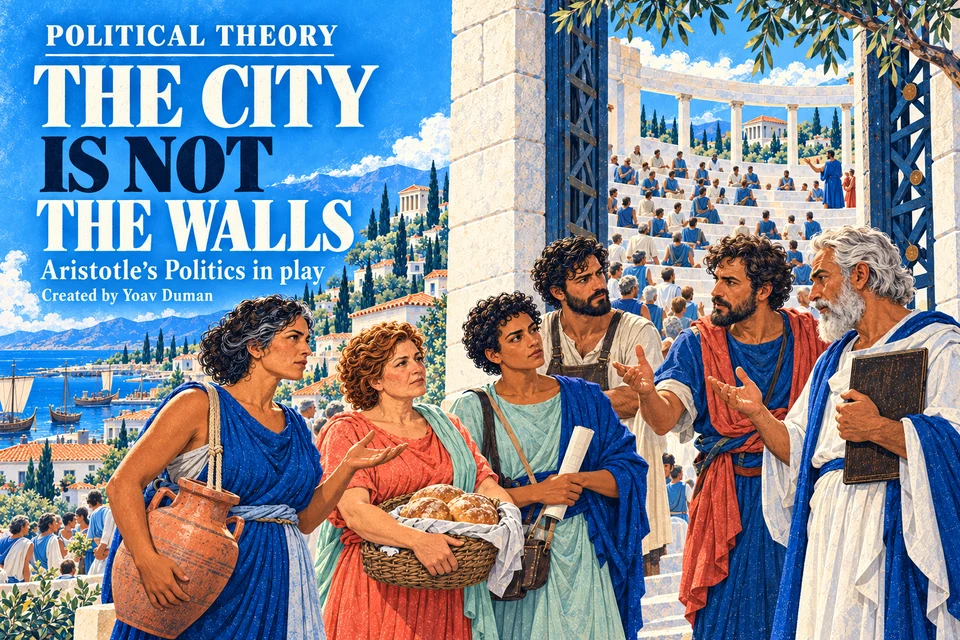
Start here
The council of Kallia has fallen. The city still needs water, bread, care, and decisions. You will propose a charter, hear six residents challenge it, and use Aristotle to examine your reasons. No earlier reading of Aristotle is required.
Plan for about 70 minutes. This is an estimate, not a timer. Take longer when you need it, and pause between rounds. Your task is to understand an argument well enough to use it and question it. You can disagree with Aristotle.
Before you begin
- Open the simulation in a current browser. A larger screen gives the diagrams more room; the activity also has a compact layout.
- Enter the name your instructor expects on your report. Read the course instructions for the deadline and submission location.
- Keep this guide nearby if useful. The activity itself includes definitions, source cards, character notes, and help.
Created by Yoav Duman. Political Theory. Revised inquiry edition, October 2026.
Follow the argument
Each round gives you enough information to begin. Read the situation, inspect the relevant source or diagram, and make a choice. Explain the connection between a reason and the power you assign. A resident can contribute something essential without that fact alone settling every question about authority.
| Round | Question to carry with you |
|---|---|
| 1 Who is the city | Who has a recognized share in public decisions, and on what grounds? |
| 2 Living together | How can different functions cooperate without making the city one household? |
| 3 A claim to rule | Who holds ultimate authority, and whose advantage does rule serve? |
| 4 Whose judgment | What can experts, users, and citizens each contribute to judgment? |
| 5 Above rules | When might discretion be justified, and how could it be held accountable? |
| 6 What carries over | What follows from a changed constitution, and what needs further evidence? |
Words that do important work
Polis means a political community. A constitution is its arrangement of offices and ruling authority, not simply a written document. Aristotle identifies citizenship through a recognized share in deliberation or judgment; residence and useful work alone do not define it.
An office is a particular public role. The person managing the water schedule need not hold the power to change the charter. Trace who authorizes, reviews, appoints, and removes before you label an arrangement.
A premise is a claim an argument relies on. To test an argument, identify that claim and ask whether the case supports it. Rejecting a conclusion is stronger when you explain where the reasoning goes wrong.
Write and reconsider
The activity asks for 11 short explanations and five extended arguments. Each prompt shows its own minimum and suggested length. The combined minimum is 365 words; about 630 words are suggested. A word count helps you complete the task. Your instructor judges what the writing shows.
- Reconstruct the relevant argument in your own words before evaluating it.
- Use a particular resident, charter rule, or piece of supplied evidence. Explain why it matters.
- Take an objection seriously. You may defend your choice, revise it, or explain what remains uncertain.
Two factual misunderstandings can open a brief contrasting example. Follow it and return to your saved explanation. After at most two attempts, a worked explanation is available. Your first answer stays in the report. Using help is part of learning.
If you change an earlier rule, the activity may ask you to review writing that depended on it. Your words stay saved. Revise them if necessary, or explicitly confirm that they still fit.
Save and submit
- Work saves in this browser when browser storage is available. Clearing site data, private browsing, or switching devices can interrupt that continuity.
- Use the activity's backup download before a break. Keep the JSON progress file; restore it inside the activity to continue on another device. A backup is not the report to hand in.
- At the end, finish the checklist and export your final PDF. Open the PDF and check your name, decisions, and all written responses. If PDF export fails, try the print or text export and follow your instructor's instructions.
- Upload the final PDF to Canvas or the location your instructor specifies. Saving, printing, and downloading do not submit your work.
Bring one distinction you can now explain and one question you want the class to examine. Personal transfer is optional; you can use a hypothetical example without sharing private experience.