Use in class
The offline game, cover, instructor guide, and optional reading guide.

Israel–Palestine, explored through interactive cases.
What makes a right usable?
Follow people trying to reach a job, claim service benefits, live together, and return home under a court order. Use Shafir and Peled’s Being Israeli to explore who qualifies, who decides, and how rights become usable.
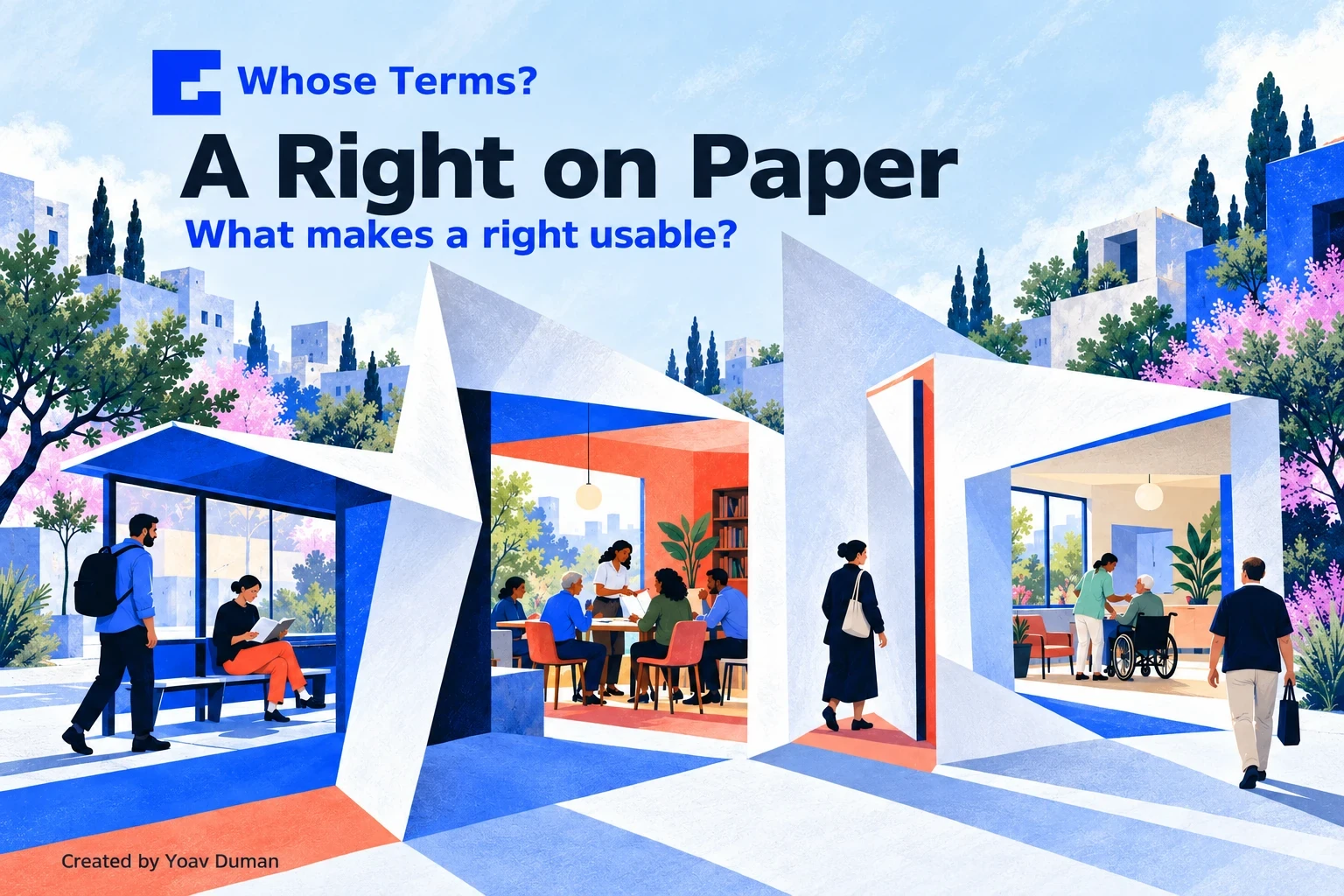
Read a case. Choose a next step. Explain why.
Help Samira pursue a usable route to work. Consider the terms of a benefit and a couple’s wish to live together. Then investigate what must happen after a court orders a family’s return. Your task is to explain how the institution shapes the outcome.



The scholarship behind the case
Gershon Shafir and Yoav Peled, Being Israeli: The Dynamics of Multiple Citizenship (2002).
Learn how liberal, republican, and ethno-national claims combine through institutions that distribute rights, resources, and belonging. Follow an explanation before evaluating it.
Read the publisher’s introduction excerpt (opens a new tab) ↗The linked PDF is an introduction excerpt; the later passages require the complete book. The game supplies the concepts needed for its tasks.
The authors’ historical argument, later dated documentary evidence, and constructed teaching decisions are identified separately. Samira’s grant choices do not change the documentary Jalud sequence. The source authors are credited for their scholarship; this is a simulation created by Yoav Duman.
Yoav Peled on ethno-national populism, 1977–2022 ↗ asks how economic gains and losses interact with political mobilization. This extension uses the author-institution abstract.
Nadim Rouhana and Areej Sabbagh-Khoury on settler-colonial citizenship ↗ offers another way to frame the relationship between Israel and its Palestinian citizens. The in-game comparison is based on the verified abstract.
For instructors / Ready to use
Designed for introductory students. Concepts arrive when needed, with additional context available on request. Class mode records required reasoning; Explore makes writing optional. Assess the author’s argument, evidence, mechanisms, and transfer. Students can disagree with evidence.
Allow about 90–120 minutes for the full class activity. This is a planning estimate; writing and discussion affect the pace. The 20 scenes form eight chapters. Keep their order and pause between chapters, or split across two meetings; the health-reform chapter offers a useful break.
Work saves in the current browser. Download a JSON backup before changing devices or file locations. Students export a PDF or semantic HTML record and submit through your course. Desk notes stay out of submission records unless the student includes them. The case does not submit automatically to Canvas.
Read the instructor guide, chapter plan, and suggested rubric →
The offline game, cover, instructor guide, and optional reading guide.
Hero images, a branded website cover, four social formats, approved identity, all 22 game illustrations, copy, and alt text.
All classroom and website materials, with graphics and provenance.

