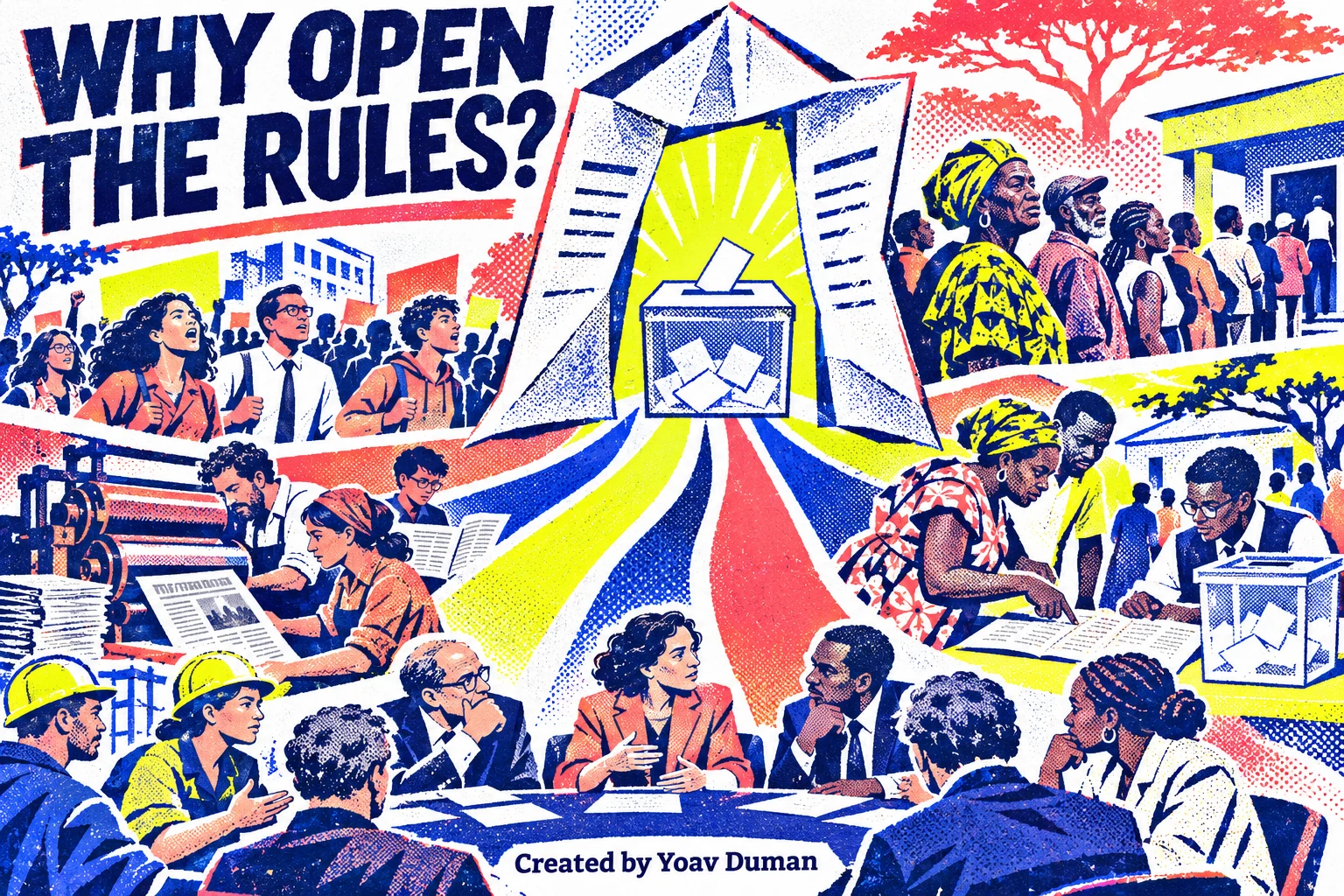
If people in power control the rules, why accept a contest they could lose?
A protest grows. A ruler offers a bargain. An election exists, but opponents still refuse to compete. Advise actors in South Korea, Taiwan, South Africa, Poland and Ghana. Predict a response, follow a second decision, then test your explanation against the historical record. Compare two cases and apply what you learned to a new political problem.
Free to play · Self-paced; choose 2–5 cases for Class · No student account
Created by Yoav Duman / יואב דומן
Political openings, bargaining & comparative causal reasoningEnter the activity ↓
01
Read three short evidence cards, advise an actor and predict another actor’s response.
02
Face a second situation, then compare the imagined route with sourced history and a number.
03
Reconsider your own claim, compare two countries and defend conditional advice for Orvessa.
Your turn
Make a choice. Follow it through.
Explore freely, try Practice with claim checks, or choose Class and complete your assigned countries. Save a progress backup before moving between devices or websites.
No advance reading or country knowledge required. Facts, definitions and sources are supplied. Explore freely, Practice with claim checks, or complete the countries your instructor assigns in Class. All five are selected by default; Class requires at least two.
Assess a clear causal connection, a specific historical detail, the correct number and its limits, a comparison and evidence-based reconsideration. Political advice is not scored. Claim checks provide formative feedback; word minimums check length, not reasoning. Instructors review the explanations.
In Class, complete your assigned countries, the two-country comparison and the Orvessa prediction/reflection. Partial reports and JSON backups remain available. Type responses in the game; the printable assignment is a reference, not additional required writing.
The HTML game works offline. Guide and original-source links use the internet. Progress backups restore work; reports are for reading and submission.
Keep the claim within the evidence.
The five country records are historical; branch reactions are simplified invented possibilities and do not change that history. The final Republic of Orvessa is fictional. These selected openings do not establish why similar pressures sometimes fail to produce reform. The activity supports guided reasoning; learning gains and completion times have not been established by a classroom pilot. Cover art is symbolic, not historical evidence.