For students
A short start, writing space, and the evidence within reach.

Israel–Palestine, explored through interactive cases.
What can a seat at the table actually change?
Advise a fictional Palestinian civic committee under the British Mandate. Use Rashid Khalidi’s The Iron Cage to investigate representation, public work, and the powers a seat at the table may leave untouched.
Public work / Political standing / Reserved power
Choose delegates. Consider an agency offered on unequal terms. Prepare for a meeting in London. Fund a service and confront the conditions attached to public speech. Your committee can make meaningful choices while powers remain elsewhere.
The notebook follows documented circumstances from 1920 to 1936, then moves explicitly to a present-day workshop. Inspect a 1939 policy, change one model rule, and ask what evidence your explanation still needs.
Pin source cards beside your response on a larger screen or in the inline reference panel on a phone. Tap or focus key terms for definitions. Historical sources and the committee model keep distinct labels and colors. At two moments, compare your first recorded reason with what you say after seeing the outcome.
There is no hidden statehood victory or required agreement with Khalidi. The written record is where you explain, qualify, and revise an argument.
Scholarship / Documents / Constructed decisions
Rashid Khalidi, The Iron Cage: The Story of the Palestinian Struggle for Statehood (2006; Oneworld edition, 2007).
The core reading is chapter 2, printed pp. 31–64. Marked extensions use chapters 1, 3, and 4. All background and source cards needed for the activity are included.
Read the 20 source cards, limits, references, and glossary →The civic committee and its teaching characters are fictional. Their letters, funding clauses, proposals, and consequences are designed. Dated documents, data, and Khalidi’s interpretation remain separately identified. Your choices do not alter the historical timeline; a programmed outcome cannot independently prove a historical explanation.
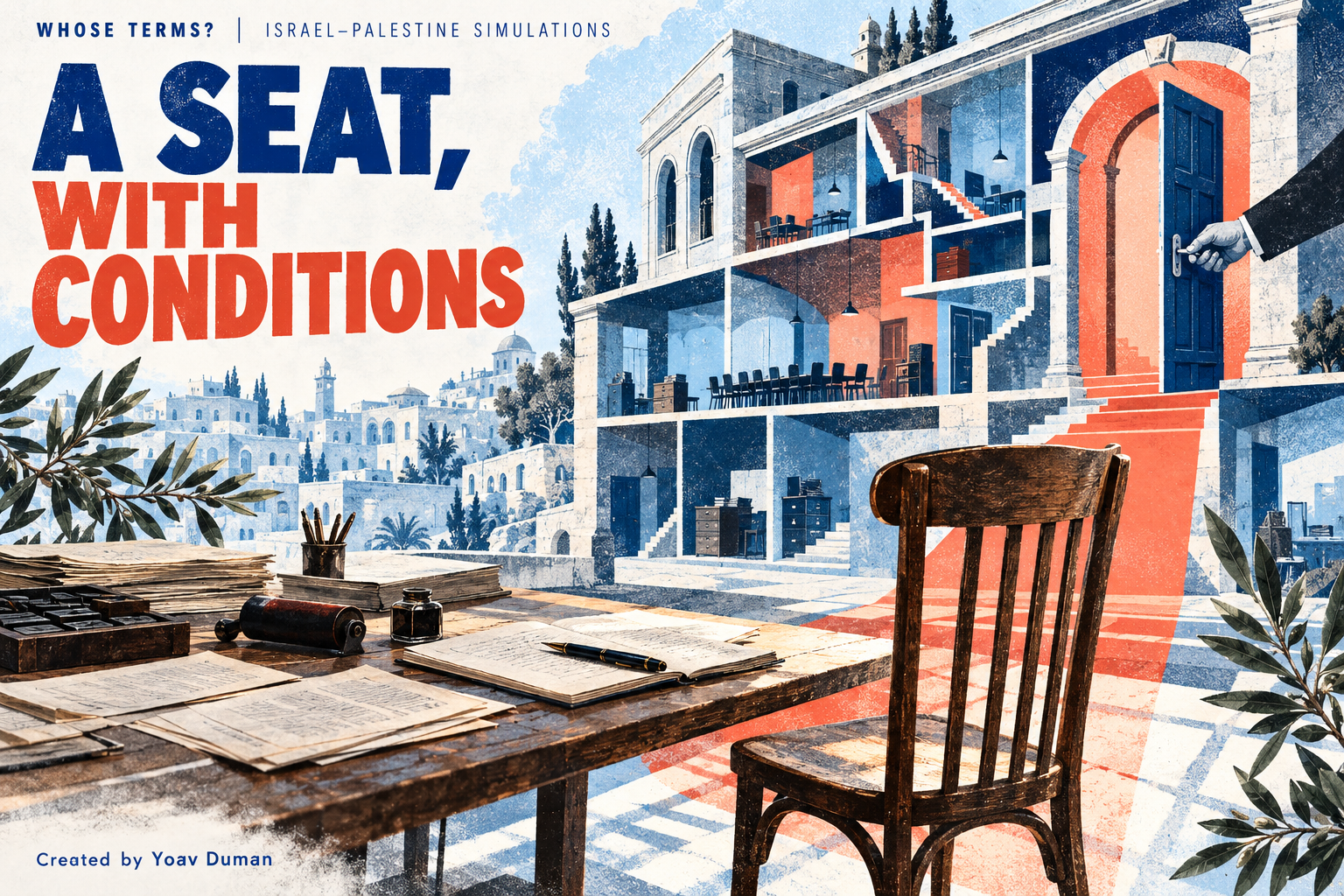
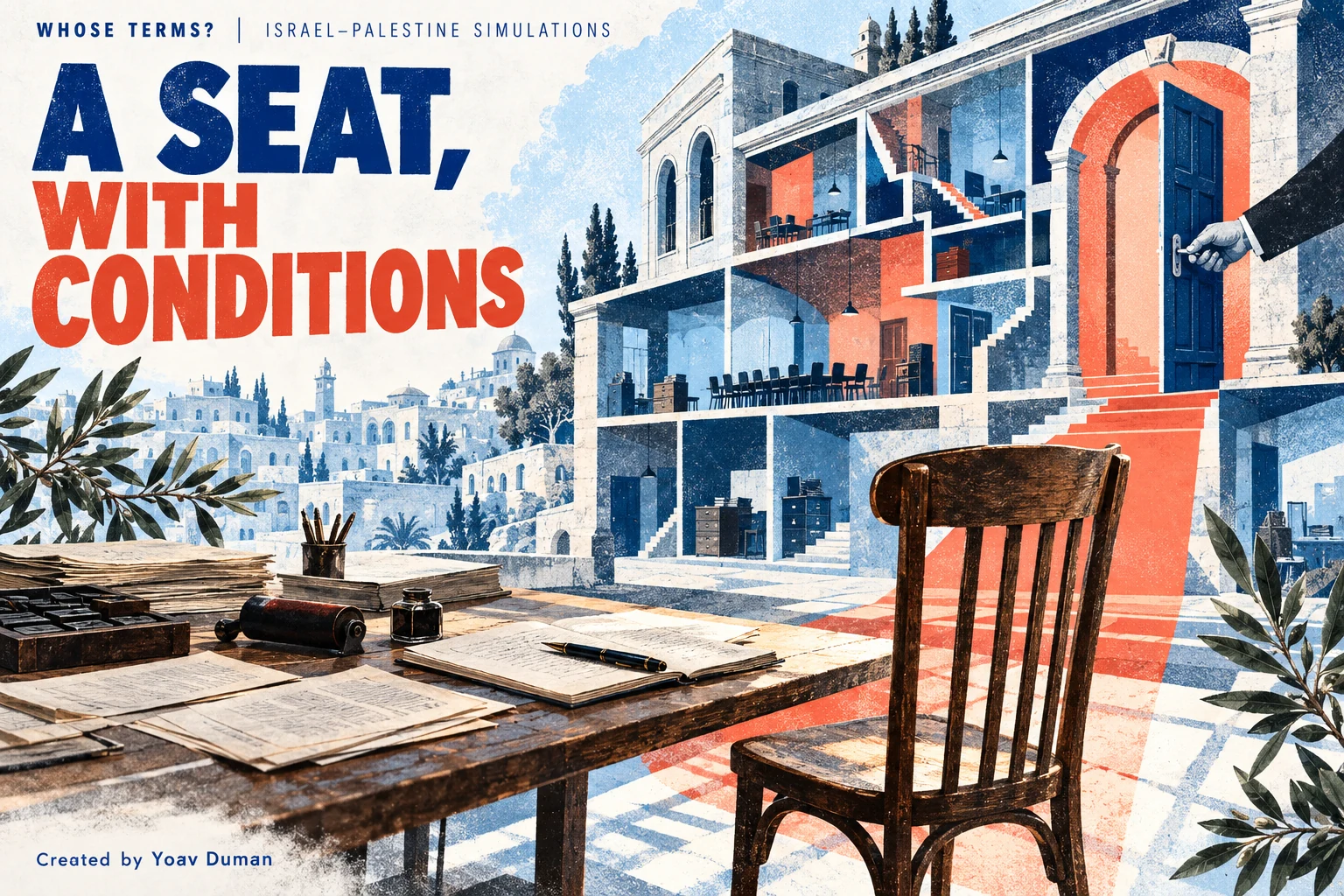
The source companion contains bounded teaching paraphrases and references, with their limits. The release does not distribute the complete book. The cover is contemporary AI-generated conceptual artwork, rather than an archival reconstruction. Khalidi is credited for his scholarship; the simulation is created by Yoav Duman.
Release 2.2 / Ready to use
Plan 90–120 minutes of active work, split after encounter 9, plus discussion and debrief time. Class mode collects short reasoning and two after-outcome reflections. Practice makes writing optional. Students can discuss in pairs and keep individual records.
New Class sessions include a midpoint portable-backup step: request a JSON export or use the manual progress-text route. Ask students to verify that they kept it and take a real break. Earlier saves remain compatible and may not enforce the checkpoint.
Use JSON export/import when moving between online and downloaded copies or changing devices. At the end, students export a readable PDF, HTML, or text record and submit through your course system. The simulation does not submit automatically.
Assess mechanisms, appropriate evidence, source limits, and thoughtful reconsideration. The instructor guide includes a suggested rubric. Timing estimates and simulated design reviews are disclosed as such.
A short start, writing space, and the evidence within reach.
Facilitation, two-part pacing, assessment, and assignment copy.
The complete release, plus full key art, social layouts, and approved identity.