POLITICS. TEACHING. OTHER QUESTIONABLE INTERESTS.

Teaching / Open the question

CLASS
WORK.

The world is complicated.
The worksheet should know that.

Simulations, visual arguments, syllabi, and things to try in a room full of people. Built to make ideas do some work.

Use something. Tell me what happened.

8 resources

Frontiers Simulations

Step into current political research. Make a prediction, follow the evidence, and see what changes your mind.

Explore the Frontiers collection
Clear filters
01
Frontiers Simulations

Simulation

Everyone Says Democracy

A commission hears strong support for democracy and predicts that citizens will defend its institutions. You investigate that inference in fictional Bellmere. Two studies help you distinguish institutional support, democratic understanding and candidate choice, while showing why a convenient scale can lose important content. Follow linked respondents through exact comparisons, interpret a separate numerical exercise, and build a usable instrument within a twelve-slot budget. Then develop your own account in a new public-media case and design a comparison that could distinguish it from a rival. Your conclusions must respect legal powers, missing observations and the distance between hypothetical choices and actual votes. Created by Yoav Duman.

Explore simulation
02
Frontiers Simulations

Simulation

The Persuasion Hearing

A supplier offers a chatbot for a public transit consultation, backed by a certificate showing that stored demographic profiles are disconnected. As an adviser to Bridgehaven’s Civic Technology Commission, you must decide what evidence a license needs. Read two recent AI-persuasion studies, check six sentences against official notices, reconstruct a proposed causal process and defend an enforceable rule within a limited audit budget. Then apply your reasoning to a fresh public-service case. Keep experimental comparisons, factual reliability, citizen access and political judgment distinct while making them inform one decision. Bridgehaven and its local records are fictional. Created by Yoav Duman.

Explore simulation
03
Frontiers Simulations

Simulation

The Overloaded State

A flood-recovery office promises decisions within ten days. Its responsibilities grow, files wait at different stages, and warnings struggle to reach the people controlling resources. You investigate this fictional office through two research lenses: the relationship between implementation work and administrative capacity, and the effects of procedures, expertise and political pressure. Build an explanation, test a credible rival, and choose one constrained pilot while preserving lawful eligibility and appeals. Then transfer your reasoning to a water authority with different tasks and powers. The challenge is to connect an institutional action to a public outcome without inventing a reform effect. Created by Yoav Duman.

Explore simulation
04
Frontiers Simulations

Simulation

The Democracy Alarm

Bellara's election dashboard and democracy report tell different stories. As an independent analyst, audit the fictional documents before deciding what the public should hear. Read a real scholarly dispute about democratic backsliding, then trace authority, decisions and access through dated records. Build a transparent measurement charter with three indicators and two different rules for combining them. Compare country and population weighting, choose a verification project under a staff-hour limit, and test your rule in an unfamiliar municipal dossier. The challenge is to defend a specific warning with evidence, keep unknowns visible and explain which observation could make you revise it. Created by Yoav Duman.

Explore simulation
05
Frontiers Simulations

Simulation

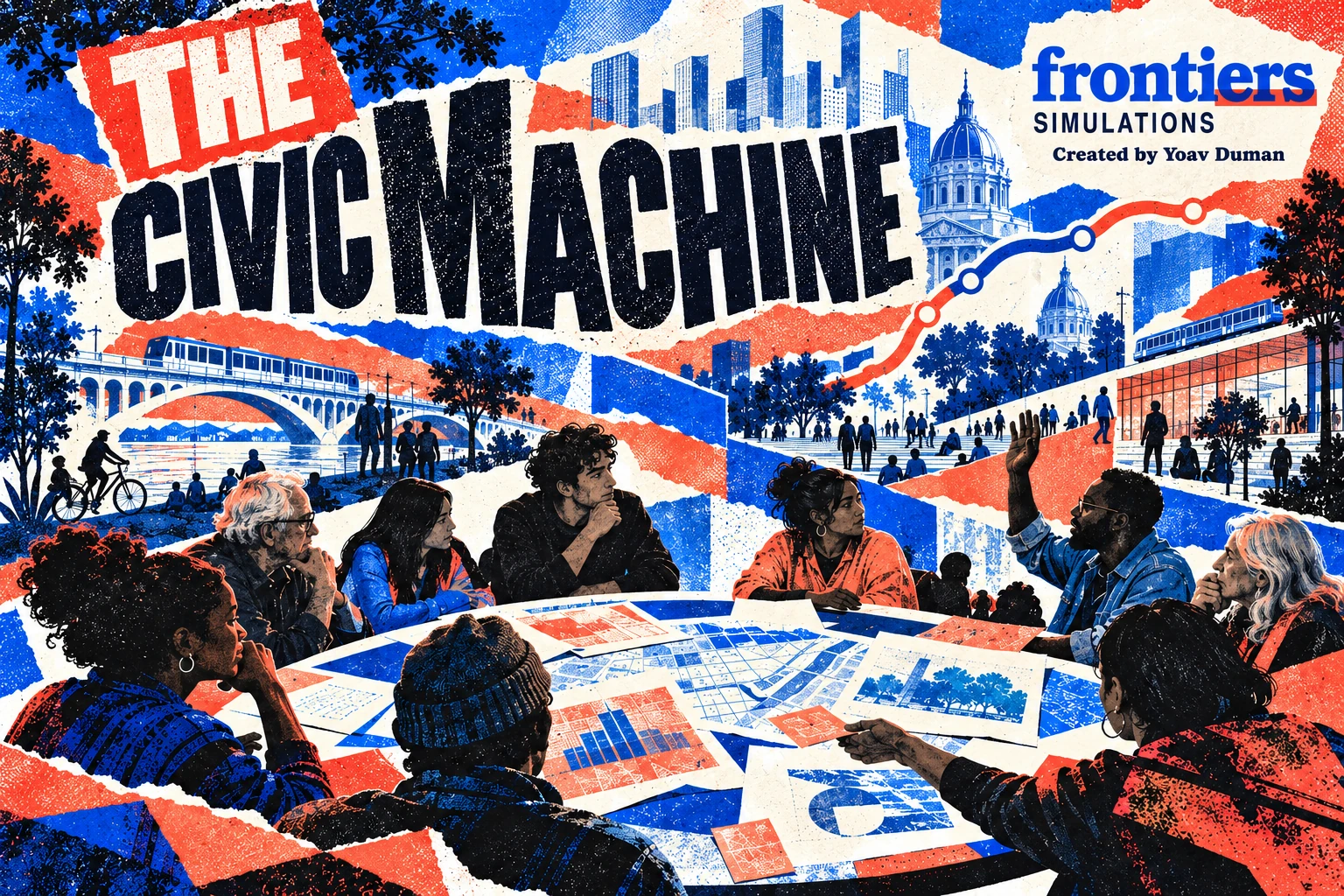
The Civic Machine

Larkhaven needs a transit decision. Residents submit priorities, an AI produces a shared statement, and the council must decide what that statement authorizes. As an independent reviewer, follow a fictional consultation through dated documents, competing explanations and exact response counts. Two real studies examine AI mediation and persuasion, helping you ask what was tested and which institutional claims remain open. Construct possible response tables, defend a route and process under a budget and access rule, then investigate a different institution. Agreement is the beginning of your inquiry. Your task is to make a precise finding and explain what could change it. Created by Yoav Duman.

Explore simulation
06
Frontiers Simulations

Simulation / 30–35-minute guided core; optional frontier +10–15

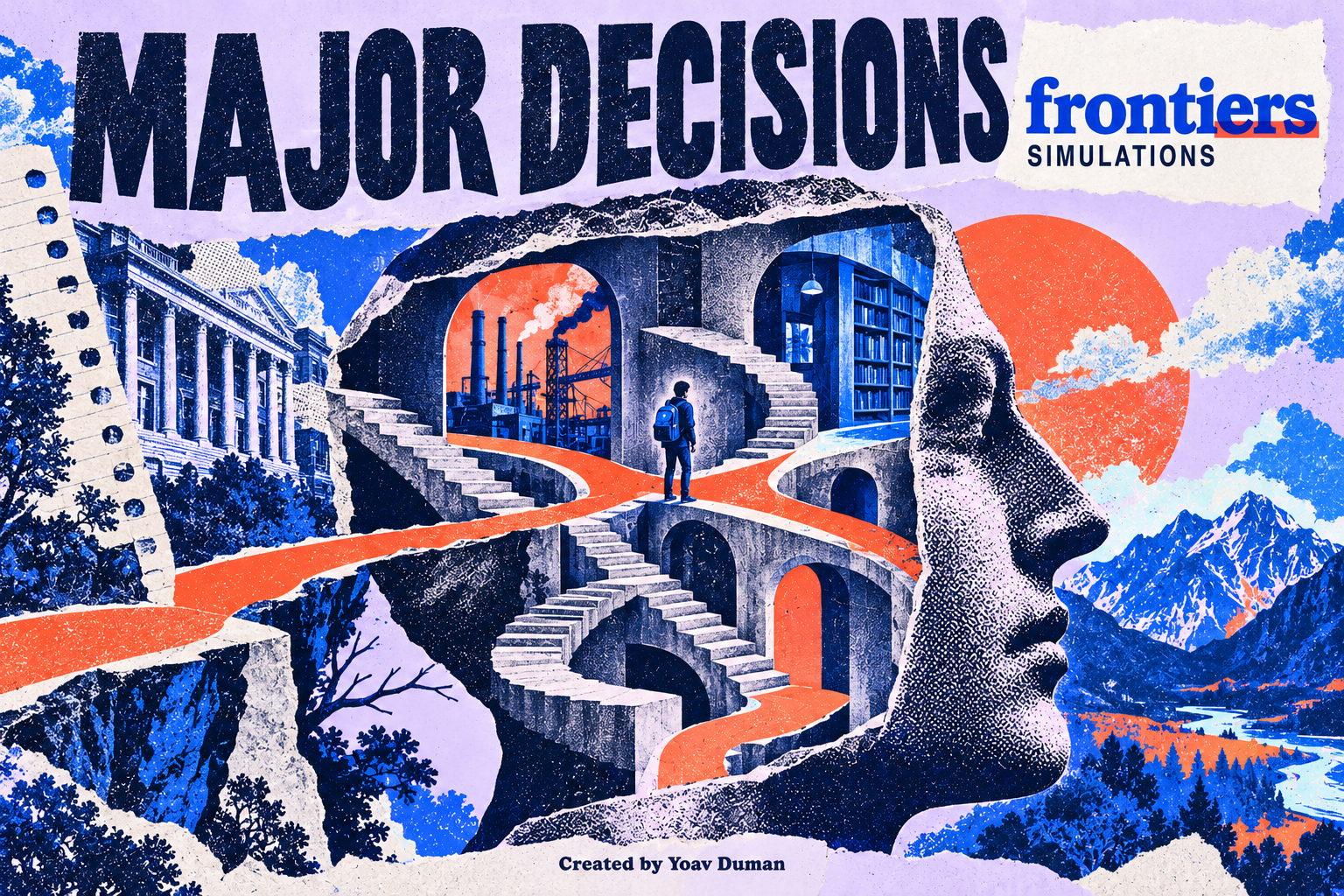
Major Decisions

A university is accused of manufacturing voters. Some political differences began before enrollment; others developed around classes, new friends, and a housing crisis. Choose an explanation, predict what evidence could distinguish it, then inspect a record and face a challenge to its timing. Two articles help separate field, attendance, policy outlook, and engagement. Play For class with a saved research brief or For fun with open browsing. An optional frontier changes the party choices while keeping preferences fixed: could a different ballot produce a different vote without changing anyone’s beliefs? Created by Yoav Duman.

Explore simulation
07
Frontiers Simulations

Simulation / 30–35-minute guided core; optional frontier +10–15

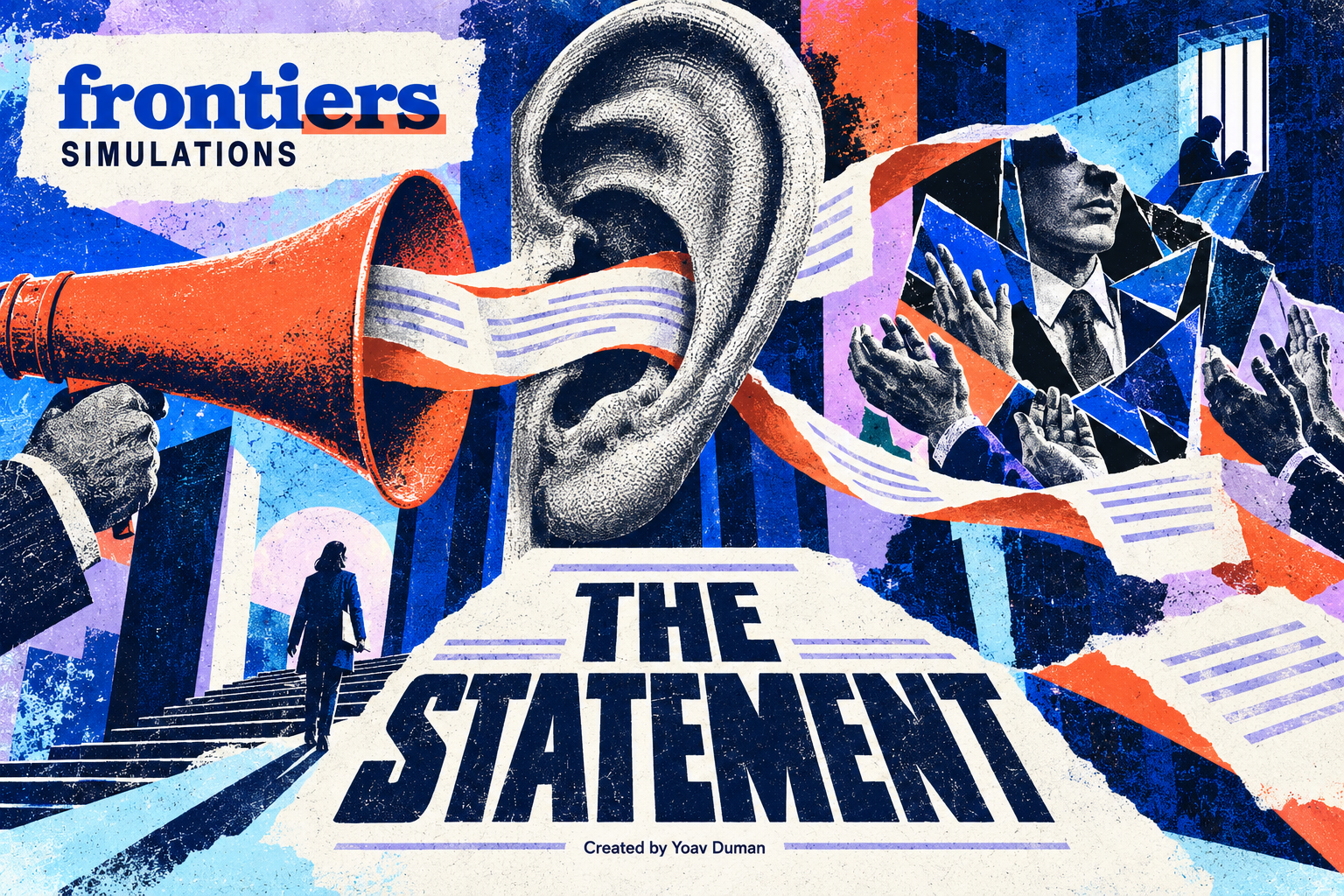
The Statement

Detainees are released after a public condemnation. The government claiming credit, the families who organized, and the diplomats who negotiated tell different stories. Choose an explanation, predict what evidence would strengthen or weaken it, and open a record before a new date challenges your account. Two research articles help separate approval, punishment preferences, and actual conduct. Play For class with a saved research brief or For fun with open browsing. An optional frontier asks whether an earlier condemnation shields a government from criticism—or makes its later violation more costly. Created by Yoav Duman.

Explore simulation
08
Frontiers Simulations

Simulation / About 36 minutes + class debrief

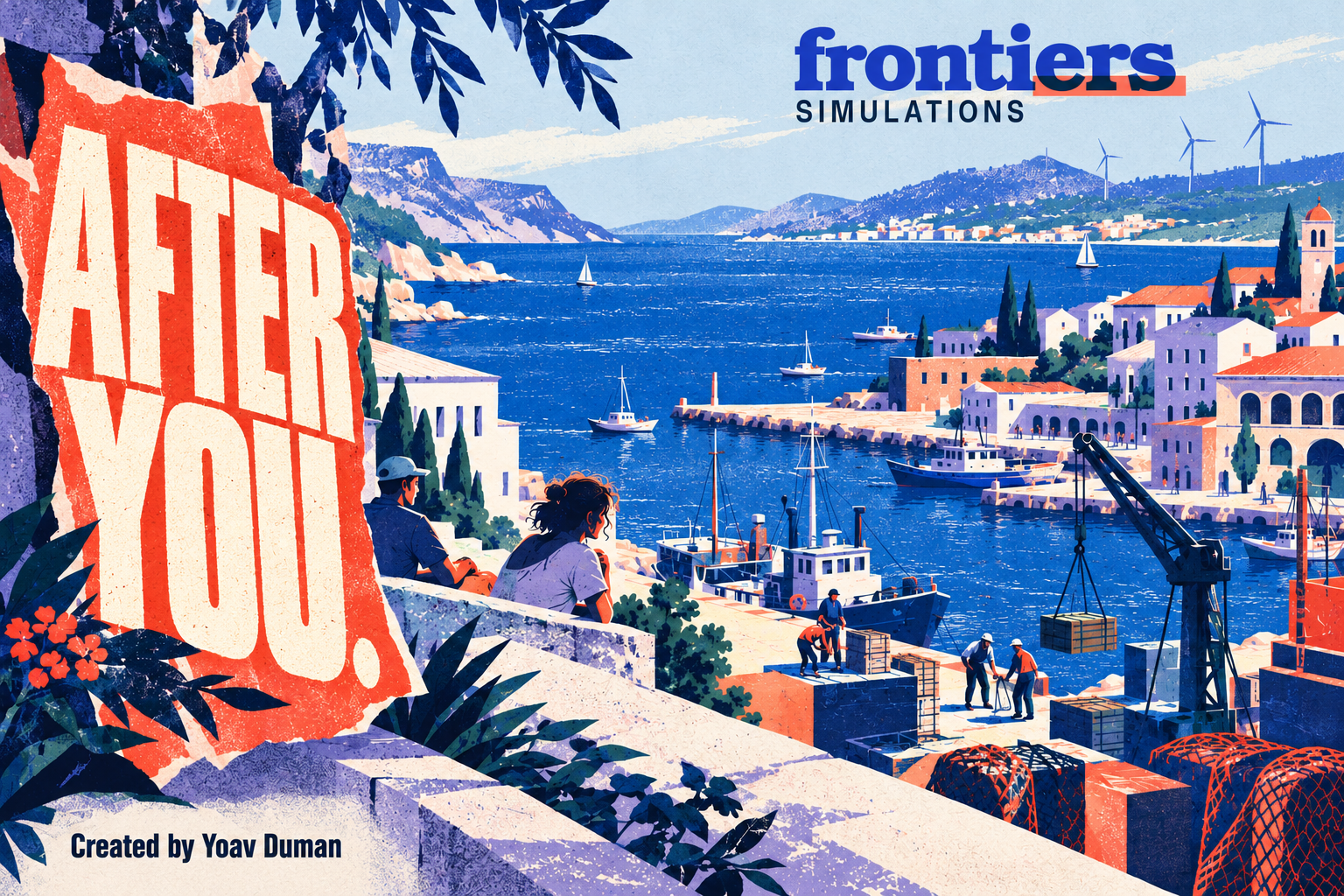
After You

A climate promise crosses borders. Politics decides what follows. Vela announces a stronger emissions target; in Luma, workers, businesses, and coastal residents have different stakes. Advise the government, predict its next move, and follow records that complicate the obvious story. Test competing explanations, revise your claim, and propose the evidence you would seek next. After You connects introductory international relations to current research on cooperation and domestic bargaining. Created by Yoav Duman.

Explore simulation

MUSE / AI & education

BETTER QUESTIONS.
BETTER CONVERSATIONS.

A little help getting from “I read it” to “I understand it.”

These learning bots help students read difficult texts, apply concepts, test arguments, and revise their thinking. Start with the source. Keep your judgment switched on.

Who Gets to be We

The Cooperation Lab — Multilateralism Partner

The Rivalry Brief

The Democracy Repair Shop

THE RULES HEARING

The Signal Room: January 6, Testimony & Power 40-60 minutes

Before You Begin Watch these three testimony videos before starting The Signal Room: 1. Police testimony: Aquilino Gonell, Michael Fanone, Daniel Hodges, and Harry Dunn https://youtu.be/a8WU8MRC2M8 2. Shaye Moss’s testimony, including recorded testimony from Ruby Freeman https://youtu.be/6dn48fcHkFw 3. Cassidy Hutchinson’s testimony https://www.pbs.org/video/the-january-6th-hearings-day-6-9racyj/ As you watch, note a few specific moments: what each witness personally experienced, what they learned from others, and what questions their account raises. Bring those observations to your conversation with Alex. Prefer to read? You can use the hearing transcripts instead: Police testimony: https://www.govinfo.gov/content/pkg/CHRG-117hhrg45472/html/CHRG-117hhrg45472.htm Shaye Moss: https://www.gov

After the Headline: The Nigeria File

Bots open in ChatGPT or Gemini. You may need an account. For classwork, follow your course’s instructions about AI.

For educators

LET THE ROOM
FIND THE PROBLEM.

I also build activities that happen between people.

My workshops start with decisions, bargaining, uncertainty, and competing priorities. Then we use theory to make sense of what just happened.

Talk workshops